
What if your best workout isn’t the one that leaves you exhausted, but the one you can keep coming back to?
Fitness often makes us believe that intensity is the ultimate goal. We push for heavier weights, harder intervals, longer workouts, and higher reps. Over time, you build a mindset that unless you leave a session completely spent, you didn’t work hard enough.
But lasting fitness progress doesn’t work that way.
Consistency in fitness is what turns individual workouts into meaningful results. Consistent workouts win every time. They build lasting strength, endurance, mobility, and confidence. Pushing yourself to the brink once in a while will never match steady progress.
At Vision Elite Training, we believe workouts should challenge you without overwhelming you. Good training should be sustainable. The best routine is one you can stick with. Because one intense workout can feel impressive. But consistent workouts are what change you.
In this article, we’ll explore why consistency beats intensity. We’ll also share how to build a workout routine you can stick with.
Consistency Is What Turns Workouts Into Progress
One workout can make you feel accomplished. But one workout alone doesn’t create lasting change.
Consistency gives your body the opportunity to adapt, recover, and improve over time.
Think about strength training. You don’t become significantly stronger because of one great lifting session. You become stronger because you train regularly, gradually challenge your muscles, recover properly, and come back to train again.
The same principle applies to almost every area of fitness.
One workout is an event. A consistent workout routine is a system.
And systems are what create sustainable results.
Why Consistent Workouts Work Better Than Occasional Hard Sessions
It’s easy to underestimate the value of a workout that feels “average.”
Maybe you didn’t hit a personal record. Maybe you didn’t finish completely exhausted. Maybe you only had 30 minutes instead of your usual hour. It still counts.
A moderate workout can still make a big difference. Do it three times a week. It can lead to better results than one intense workout followed by days of inactivity.
Regular workouts can improve your fitness levels while supporting better energy levels throughout the day.
The goal isn’t to avoid hard training. It’s to make hard training part of a bigger, sustainable plan.
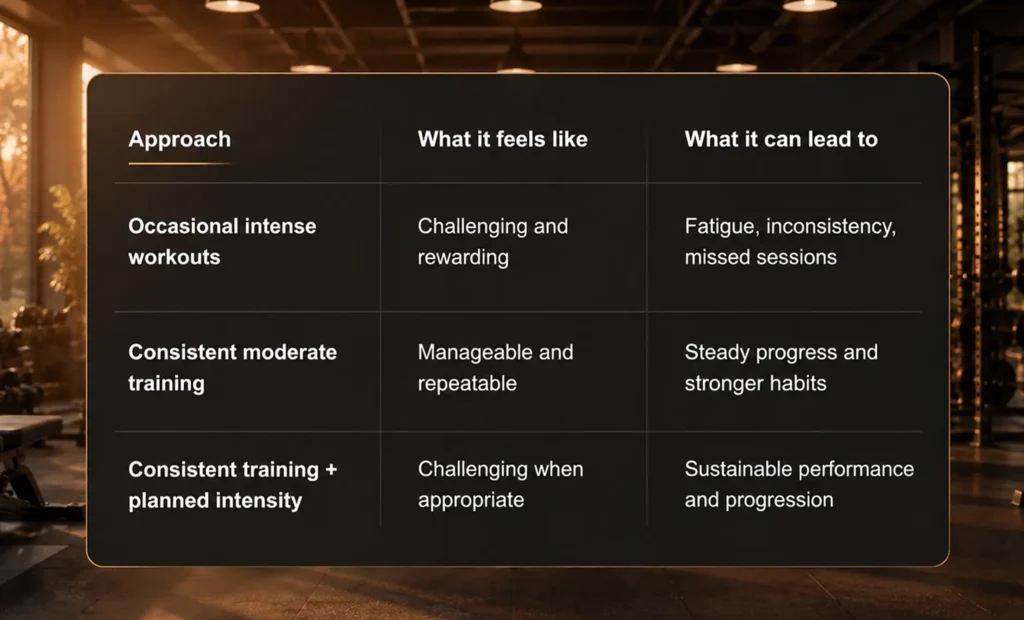
Intensity Has a Place. It Just Isn’t the Whole Plan
Intensity isn’t the enemy.
High-effort workouts can be valuable when they’re programmed appropriately. They can help you challenge your limits, improve performance, build strength, and create measurable milestones.
The problem comes when every workout has to be your hardest workout.
If you’re constantly training at maximum effort, recovery can become difficult. You may start feeling unusually tired, lose motivation, or find yourself skipping sessions because your body simply isn’t ready for another demanding workout.
Instead, think of intensity as one part of your training rather than the definition of a good workout.
A Better Way to Think About Training
Instead of asking: “How hard can I train today?”
Ask: “What training can I recover from and repeat?”
That small change in mindset can completely change the way you approach fitness.
Consistency Builds Momentum
The hardest part of many workouts isn’t the workout itself. It’s starting.
When exercise becomes part of your routine, you spend less time negotiating with yourself about whether you’re going to train. You already know when you’re going. You know what you’re doing. You simply show up. That creates momentum.
For example, imagine someone who trains three times a week:
Monday → Wednesday → Friday
Over four weeks, that’s approximately 12 opportunities to train.
Now compare that with someone who waits until they feel highly motivated and completes one extremely difficult workout every week or two. The individual sessions might feel more impressive, but the consistent routine creates far more opportunities to practice movements, build strength, recover, and improve.
Consistency doesn’t require you to feel motivated every time. It makes showing up part of the routine.

Your Workout Routine Should Fit Your Real Life
One of the biggest mistakes people make when starting a fitness routine is designing it around their ideal life instead of their actual one.
You might have a plan to train six days a week. But if your schedule realistically allows three sessions, a six-day plan isn’t necessarily ambitious. It may simply be unsustainable.
A better approach is to build your routine around what you can realistically maintain.
Consider:
- Your work schedule
- Family commitments
- Sleep and recovery
- Current fitness level
- Training experience
- Your specific goals
- How much time you can consistently dedicate to exercise
Example
Instead of: “I’ll train for 90 minutes every day.” Try: “I’ll strength train three times a week for 45–60 minutes.”
That may look less impressive on paper, but if you can maintain it for months, it becomes much more valuable.
The best workout routine isn’t necessarily the most demanding one. It’s the one you can keep doing.
Small Sessions Still Count
Consistency doesn’t mean every session has to be perfect. Some days you’ll have plenty of energy. Other days, you’ll have a packed schedule and very little time. That’s when having a flexible approach can help. If you planned a full strength workout but only have 20 minutes, you can still move. If you’re feeling fatigued, you might reduce the volume or focus on mobility and recovery. If you’re feeling strong, you can push your training appropriately.
The important thing is to avoid the all-or-nothing mindset.
The “Something Is Better Than Nothing” Rule
A shorter session might look like:
- 10 minutes: Mobility
- 20 minutes: Strength training
- 10 minutes: Cardio
- 5 minutes: Cooldown
It isn’t the same as your full workout.
But it keeps the habit alive.
And over time, those smaller efforts can add up.

Recovery Is Part of Consistency
Training is only one side of the equation. Recovery is what allows you to keep training. Your body needs time to adapt to the demands you place on it. Sleep, nutrition, hydration, rest days, and appropriate training volume all play a role in maintaining a sustainable fitness routine.
This is also why more isn’t automatically better.
If adding another workout leaves you constantly exhausted and affects your ability to perform during your next session, it may not be helping your overall progress.
A consistent approach considers both sides:
Train → Recover → Adapt → Repeat
That cycle is what allows you to continue progressing without constantly starting over.
Recovery
Your workout ends when you leave the gym. Your body’s work doesn’t.
Recovery continues long after the final rep. Nutrition, hydration, rest, and sleep all play a role in helping your body prepare for what comes next.
If you train hard on Monday but spend Tuesday feeling completely depleted, the answer isn’t always to push harder. Sometimes, the smarter move is to recover better.
How to Build a Fitness Routine You Can Actually Stick To
If consistency is the goal, make your routine easier to follow.
1. Schedule Your Workouts
Treat your workouts like appointments. Choose specific days and times instead of relying entirely on motivation.
2. Start With a Realistic Number of Sessions
If three workouts fit your schedule, start with three. You can always increase your training later.
3. Set a Minimum
Give yourself a baseline.
For example:
“On busy days, I’ll do at least 20 minutes.”
This gives you flexibility without abandoning your routine.
4. Track Your Progress
Don’t only track weight or appearance.
Look at:
- Reps
- Weight lifted
- Workout frequency
- Endurance
- Mobility
- Energy
- Recovery
- How movements feel
Progress isn’t always visible in the mirror.
5. Leave Room for Life
A sustainable routine should survive a busy week.
If missing one workout causes you to abandon the entire plan, the plan may be too rigid.
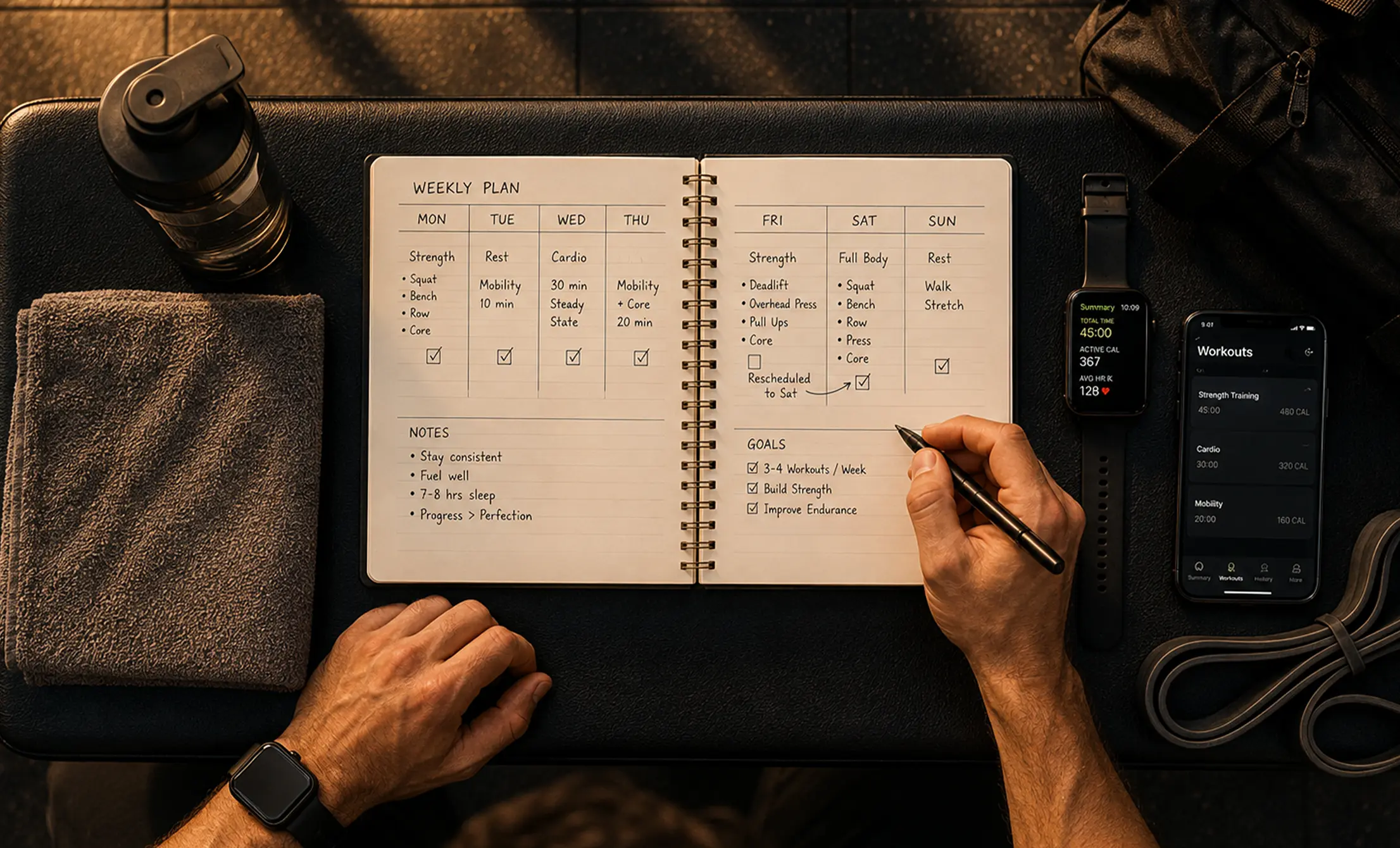
What Consistency Can Look Like in Real Life
Let’s say your goal is to improve your strength.
You don’t need to make every workout a test of your maximum ability.
Instead, you might gradually increase the challenge while maintaining a predictable training schedule.
Week 1: Establish your routine
Week 2: Repeat and refine technique
Week 3: Add a little weight or volume
Week 4: Continue progressing or allow for more recovery
The exact approach will depend on your goals, experience, and training program, but the principle remains the same:
Give your body a challenge it can adapt to, then give it another opportunity to do it.
That’s how individual workouts become long-term fitness progress.
Consistency Doesn’t Mean Doing the Same Thing Forever
There’s another important distinction:
Consistency doesn’t mean repetition without progression.
Your body adapts. As you become stronger or fitter, your training needs to evolve with you.
That could mean:
- Increasing resistance
- Adding reps
- Improving technique
- Increasing training volume
- Introducing new exercises
- Changing training intensity
- Working toward a new performance goal
The routine provides the foundation. Progressive training gives that foundation somewhere to go.
The Goal Isn’t to Train Harder. It’s to Keep Moving Forward.
Fitness doesn’t have to be an endless competition with yourself. There will be days when you have the energy to push harder. There will also be days when showing up for a shorter, easier session is the smarter choice.
Both can be part of a successful fitness journey.
At Vision Elite Training, we take a personalized approach to training because progress doesn’t look exactly the same for everyone. Your workouts should reflect your goals, your current fitness level, and what you can realistically sustain. The goal isn’t to win one workout. It’s to keep building on the last one.

Consistency Beats Intensity Because Progress Compounds
The workout that changes your fitness isn’t necessarily the one that leaves you sore for three days. It’s the workout you can recover from.
Then repeat. And repeat again.
Over weeks and months, those sessions become strength. They become endurance. They become confidence. Most importantly, they become a lifestyle rather than another short-lived fitness challenge.
Intensity can push you forward. Consistency keeps you moving.
And when the two work together, that’s where sustainable fitness progress happens.
Ready to Make Training Part of Your Routine?
At Vision Elite Training, our personal trainers create workouts around your goals, fitness level, and lifestyle. Whether you’re getting back into fitness or ready to take your training further, we’re here to help you build a routine that lasts.
Show up. Train smart. Recover. Repeat.
That’s how fitness becomes a lifestyle